Can Polkadot (DOT) Make a Comeback in 2027? Key Factors That Could Drive the Next Bull Run
Polkadot Is Starting From a Damaged Base
A Polkadot comeback would begin from one of the deepest drawdowns among major blockchain projects. On 17 September 2026, DOT traded near $1.01, compared with an all-time high of $54.98 in November 2021. CoinGecko also recorded a new low of $0.727 in August 2026. The market is no longer pricing Polkadot as a likely winner. It is asking whether the network still has a reason to matter.
That low starting point creates both the opportunity and the trap. A small improvement can produce a sharp percentage rally, but a durable DOT bull run needs more than bargain hunting. By 2027, investors will want evidence that Polkadot's technical redesign is attracting applications, users and capital rather than simply giving long-term holders a new story.
Polkadot Hub Could Make Building Much Simpler
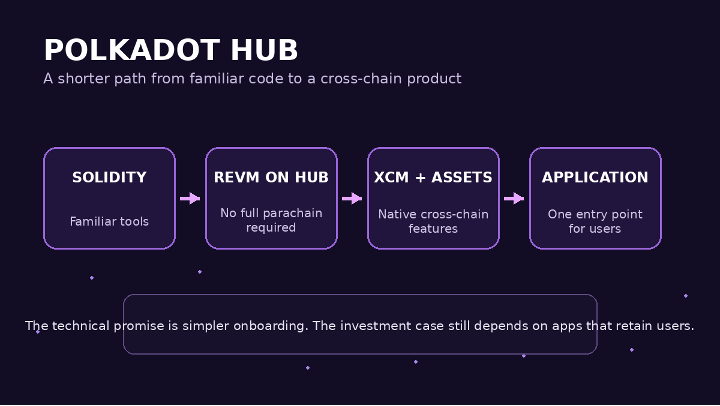
The clearest near-term catalyst is Polkadot Hub. Earlier versions of the ecosystem often asked teams to understand parachains, governance, core allocation and specialised tooling before reaching users. The Hub is designed as a single entry point for smart contracts, assets, identity, staking, governance and bridges. An application can use shared Polkadot services without operating its own chain.
That matters because developer attention is scarce. The Hub supports Solidity smart contracts through REVM, along with familiar tools such as Hardhat, Foundry, Remix and MetaMask. It also connects contracts to native features including XCM, assets and governance. If teams can move an Ethereum application with limited changes, Polkadot becomes easier to test. The decisive question is whether easier deployment turns into products people continue to use.
Coretime and Elastic Scaling Improve the Product
Polkadot is also changing how projects buy network capacity. Under Agile Coretime, teams can purchase 28 days of bulk capacity, split or share it, or pay for on-demand coretime block by block. This replaces the old perception that every project must commit to a costly, fixed slot before it knows how much demand will arrive.
Elastic scaling extends the model by allowing a parachain to use several cores at once. Polkadot's documentation gives a simple example: four blocks take about 30 seconds with one core and about 18 seconds with two. The system therefore offers a credible route to higher throughput without forcing every application to overpay from day one. For DOT, however, the value link must become visible through real coretime demand and stronger network fees.
JAM Is the Largest Catalyst and the Largest Execution Risk
The long-term technology bet is JAM, or the Join-Accumulate Machine. It is a proposed successor to the relay chain that combines Polkadot's shared computation model with a more permissionless service environment. Developers would be able to deploy code as services and purchase computation through coretime, while the network handles secure parallel processing.
JAM could make Polkadot more flexible than its original parachain design, but it should not be valued as a finished product. The Polkadot Wiki describes it as a prospective design and a single major upgrade rather than a series of small changes. That creates substantial engineering and coordination risk. A clear testnet path, several independent client implementations and a believable migration plan would be stronger 2027 signals than another roadmap announcement.
Tokenomics Are Finally Easier to Understand
For years, DOT inflation weakened the investment case because supply expanded while demand for auctions and network activity disappointed. The new model introduces a maximum supply of 2.1 billion DOT and reduces issuance in steps every two years beginning in March 2026. CoinGecko reported about 1.7 billion DOT in circulation in mid-September 2026, so the cap is meaningful but still leaves room for additional supply.
A hard cap can improve confidence, yet scarcity does not create demand by itself. The better bull case is a combination of slower issuance and more reasons to hold or use DOT: staking, governance, coretime purchases, transaction fees and activity across the Hub. If usage remains weak, the supply reform may only reduce one source of selling pressure rather than reverse the trend.

A Nasdaq ETF Opens the Door but Demand Is Still Small
Institutional access improved in March 2026 when 21Shares launched the Polkadot Staking ETF (TDOT) on Nasdaq. The fund offers spot DOT exposure and can stake part of its holdings, with net rewards intended for quarterly cash distribution. This gives brokerage and retirement accounts a regulated route that does not require a crypto wallet.
The early numbers also impose discipline on the story. TDOT reported roughly $10.6 million in assets as of 10 September 2026. That is evidence of access, not yet evidence of large institutional demand. Sustained inflows would help a comeback; a small ETF that attracts little new capital would not. Broader market liquidity will matter too, as Vision Factory's Bitcoin analysis showed when examining rates, risk appetite and crypto valuations.
The Missing Piece Is Real User Activity
Polkadot now has a more coherent technical offer than it had during the parachain-auction era. The remaining problem is commercial. A network can publish strong benchmarks and still fail to build liquidity, developer mindshare or applications that users return to. In 2027, the most useful indicators will be retained users on Polkadot Hub, stablecoin and bridge liquidity, application fees, active developers and paid coretime demand.
This is also why price alone can mislead. A broad altcoin rally could lift DOT without changing its competitive position. The stronger signal would be activity improving before or alongside price, especially if teams deploy through the Hub and use XCM without forcing users to understand the network's architecture.
What Could Prevent the Comeback
Execution is the first risk. JAM may take longer than expected, elastic scaling must work reliably under real load, and a major migration can distract builders. Competition is the second. Ethereum rollups, Solana and newer high-throughput chains already have larger pools of users, liquidity and familiar applications. Polkadot must win attention rather than assume its architecture will be appreciated.
The final risk is a weak crypto market. DOT remains a volatile altcoin, and even successful upgrades may struggle if capital stays concentrated in Bitcoin or leaves digital assets altogether. The August 2026 low shows how quickly technical narratives can lose importance when buyers disappear.
So Can DOT Make a Comeback in 2027?
Yes, but the standard should be higher than a temporary rebound from $1. Polkadot Hub can lower the barrier for Ethereum developers, Agile Coretime and elastic scaling can make capacity more flexible, and the new 2.1 billion DOT cap gives investors a clearer supply path. TDOT adds a new channel for institutional participation, while JAM preserves a serious long-term technology thesis.
None of those factors guarantees a bull run. The credible 2027 case requires visible progress in three places at once: developers shipping on the Hub, users and liquidity staying on the network, and token demand growing faster than new issuance. If those numbers improve, DOT could move from a recovery trade to a genuine comeback. If they do not, better technology may remain disconnected from the token price.