The 2026 Software Selloff5 Beaten-Down Stocks That Could Be the Next Multi-Baggers
Intro: Software
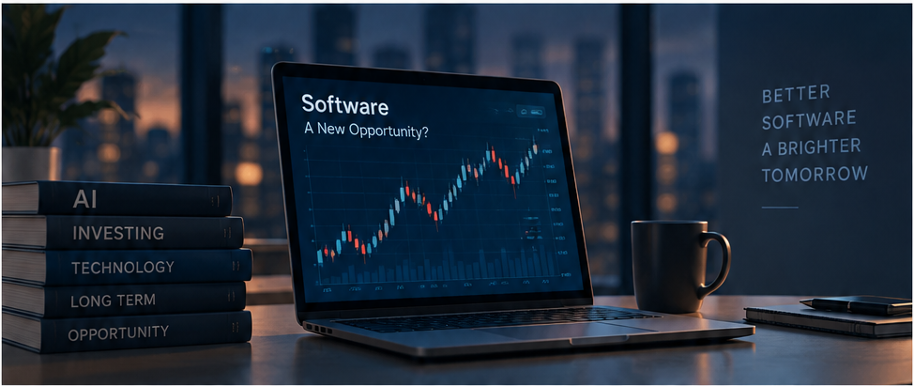
The software industry has endured one of its most difficult periods in years. Investors have become increasingly concerned that artificial intelligence could disrupt traditional software business models, compress pricing power and make some applications less valuable.
The result has been a major selloff across the sector. The S&P 500 Software and Services Index fell more than 33% from its October 2025 peak to its April 2026 low, according to Reuters.
But a falling stock price does not automatically mean a company is broken. In some cases, the market may be pricing in an overly pessimistic scenario.
Here are five software companies worth watching as potential long-term turnaround stories.
1. ServiceNow (NYSE: NOW)
ServiceNow has been one of the most heavily punished enterprise-software stocks in 2026. At one point, the shares were down around 40% year to date.
The concern is understandable: investors worry that AI agents could automate some of the workflows traditionally handled by enterprise software.
However, ServiceNow's latest results provide a different perspective. In Q2 2026, subscription revenue increased 24.5%year over year to $3.877 billion, while total revenue increased 24%. Its remaining performance obligations also increased 21%.
Even more importantly, ServiceNow said its AI business crossed $1 billion in annual contract value during the quarter.
The bull case: If ServiceNow can use AI to make its platform more valuable rather than allowing AI to replace it, the current pessimism could eventually look excessive.
Main risk: AI could ultimately reduce demand for parts of traditional enterprise workflow software.
2. Salesforce (NYSE: CRM)
Salesforce is another software giant caught in the 2026 AI selloff.
Investors have questioned whether AI agents could weaken Salesforce's traditional CRM model. The company is responding with Agentforce, which combines AI agents, data and its Customer 360 applications.
The interesting part of the story is that Salesforce isn't simply defending its old business model. It is attempting to turn AI into another source of growth.
The company has also remained highly profitable and has significant scale in the enterprise CRM market.
The bull case: Salesforce could become an infrastructure layer for companies deploying AI agents rather than becoming a victim of them.
Main risk: Organic growth has slowed, and investors need evidence that Agentforce can produce sustainable incremental revenue rather than simply replacing existing software spending.
3. Adobe (NASDAQ: ADBE)
Adobe may be one of the most interesting - and controversial - names on this list.
The company's shares remain well below their previous highs. As of September 3, Adobe was trading at $285.75,approximately 23% below its 52-week high.
The market's biggest concern is obvious: generative AI tools can now create images, videos and designs that previously required professional software.
Adobe, however, owns some of the world's most widely used creative and document tools, including Photoshop, Illustratorand Acrobat. Its Firefly AI products also give the company an opportunity to incorporate generative AI directly into its ecosystem.
There are genuine problems. Adobe faces competition from cheaper creative platforms, while investors are also watching its leadership transition and AI monetization strategy.
The bull case: Adobe successfully integrates AI into Creative Cloud and turns AI from a threat into a premium feature.
Main risk: AI-native competitors could permanently weaken Adobe's pricing power and customer acquisition.

4. Veeva Systems (NYSE: VEEV)
Veeva is different from many of the other companies on this list because its software is highly specialized.
The company provides cloud software specifically for the life-sciences industry, where regulatory requirements, specialized workflows and sensitive data make switching platforms more complicated.
Its recent numbers are particularly encouraging. For fiscal Q2 2027, Veeva reported $928 million in revenue, up 18% year over year, while subscription revenue increased 16% to $766.8 million.
Veeva is also incorporating AI into its products, including its Vault platform and industry-specific AI agents.
The bull case: Veeva's industry-specific data, integrations and regulatory expertise could make it considerably harder to replace than generic software.
Main risk: Its valuation can still be demanding, and growth could slow if pharmaceutical customers reduce technology spending.
5. Workday (NASDAQ: WDAY)
Workday is another beaten-down enterprise software company facing questions about how AI will change its market.
The company specializes in human resources and financial-management software, areas where companies often require deeply integrated systems rather than simple standalone AI tools.
Workday's fiscal 2027 guidance called for approximately 12-13% subscription-revenue growth and a 30% non-GAAP operating margin.
That combination - continued double-digit growth and strong profitability - could become more attractive if the market continues to punish traditional software companies.
The bull case: Workday successfully incorporates AI into HR and finance while maintaining its position as a core enterprise system.
Main risk: AI could reduce the amount of software and human input required for certain HR and finance processes, putting pressure on long-term growth.
Which One Has the Best Multi-Bagger Potential?
A "multi-bagger" is a stock that increases several times from its current price. That makes the term inherently speculative - none of these companies is guaranteed to deliver such returns.
If the AI disruption fears prove exaggerated, however, the software selloff could create an unusual opportunity.
Company | Main opportunity | Biggest risk |
ServiceNow | AI + enterprise workflow | AI disruption |
Salesforce | Agentforce + CRM ecosystem | Slowing organic growth |
Adobe | Firefly + Creative Cloud | Generative-AI competition |
Veeva | Life-sciences specialization | Slower growth / valuation |
Workday | AI-powered HR & finance | AI reducing software demand |
Final Verdict
The 2026 software selloff is not necessarily a simple story of "AI kills software." The more important question is which software companies can use AI to become more valuable and which ones will be replaced by it.
Recent results suggest that some companies are already adapting. ServiceNow's subscription revenue grew 24.5% in Q2, while Veeva delivered 18% overall revenue growth.
That does not mean these stocks are guaranteed winners. Instead, they represent companies where the market's expectations have changed dramatically while the underlying businesses continue to generate substantial revenue and cash flow.
For long-term investors, the potential opportunity may therefore lie not in buying the cheapest software stocks, but in identifying the companies whose competitive advantages remain intact after the AI shock.
Disclaimer: This article is an educational market analysis, not a recommendation to buy or sell any stock. Software stocks can be highly volatile, and a stock that has fallen substantially can continue falling.