
Why 99% of altcoins will not survive and Bitcoin will always be number one
Why Most Altcoins Fail
Every year, thousands of new tokens hit the crypto market with big promises, and most of them are gone within months. Right now, more than half of all cryptocurrencies ever listed sit inactive, according to recent industry research. Analysts have a name for what these projects turn into: "zombie coins." Technically still listed on exchanges, but nobody's actually trading them. New tokens keep popping up to fill the gap left by the ones that just died, and the cycle repeats. Launchpads that let anyone spin up a token in minutes have only sped things up.
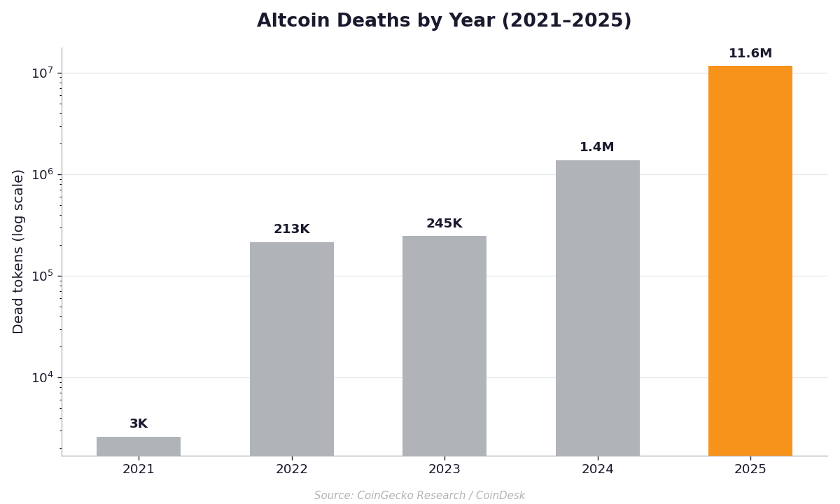
Most altcoins never had a real use case beyond hype. They exist mainly for speculation and a quick flip. A lot of teams disappear once the initial buzz dies down, and investors end up holding tokens that are worthless and hard to sell. Thin liquidity makes it almost impossible to get out without taking a big loss, and the market keeps getting flooded with copycat projects that bring nothing new, which just spreads capital and attention even thinner. To be fair, speculation is what drives most of the short-term action in altcoins. But bubbles pop eventually, and only the strongest projects are left standing when they do. The crashes of 2018 and 2025 alone wiped out thousands of smaller, weaker tokens. On top of that, fear of missing out, or FOMO, keeps a lot of that frenzy going. Social media hype talks newcomers into believing some random small token is "the next Bitcoin," and it's usually the early insiders who cash out while everyone who bought later eats the loss.
A lot of investors assume that holding a dozen different altcoins spreads out their risk.
But diversification only works if what you're holding actually has value otherwise you're just multiplying your exposure to failure across more projects. Chasing every new trend rarely builds lasting wealth in this market either.
What Sets Bitcoin Apart From Every Altcoin
Unlike newer coins, Bitcoin was the first cryptocurrency ever created, and that head start still gives it unmatched brand recognition and trust that's built up over more than a decade. Its total supply is also capped forever at 21 million coins, a hard limit that guarantees real scarcity. That's part of why people compare Bitcoin to digital gold rather than just another speculative token.
Much like the internet got more useful as more people joined it, Bitcoin gets stronger through a powerful network effect the more people use and hold it, the more valuable and secure the network becomes.
Thousands of developers, miners, and institutions keep its infrastructure running around the clock, which makes Bitcoin's network far more resilient than any single altcoin's. That kind of resilience is hard to fake and even harder to replicate quickly, no matter how much funding a new project raises.

Governments and regulators around the world are drawing clearer lines around crypto these days, and Bitcoin is often classified as a commodity rather than a security. Plenty of altcoins can't say the same many look enough like unregistered securities to face real legal risk.
That's a big reason institutional investors lean toward Bitcoin: lower regulatory risk and much deeper liquidity. Big funds and corporations keep adding Bitcoin to their balance sheets while steering clear of riskier altcoins altogether.

Regulation aside, liquidity is a big factor in who survives long term. Bitcoin's deep liquidity lets large investors move in and out of positions without much friction, while most altcoins can't absorb a big trade without the price swinging wildly. That's why institutions gravitate toward safer, more liquid assets like Bitcoin.
On top of that, Bitcoin's proof-of-work system is still the most battle-tested security model in crypto, which makes it far harder to attack than any altcoin network.
Dominant technologies tend to consolidate rather than multiply over time. Only a handful of web browsers made it out of the dot-com era, and crypto is likely to play out the same way. Bitcoin's first-mover advantage looks a lot like how early internet protocols eventually became the permanent standard.
History suggests it's the most trusted, most secure networks that stick around. Betting against Bitcoin's long-term dominance has, so far, been a losing bet.
So, Will Bitcoin Stay Number One?
Most altcoins simply don't have the fundamentals to last. Bitcoin, on the other hand, keeps benefiting from scarcity, trust, and a powerful network effect. Its regulatory clarity gives it a lasting edge over nearly everything else in the space, and Bitcoin's spot as the world's number one cryptocurrency looks awfully hard to challenge. That's why most experienced investors still treat it as the foundation of any serious crypto portfolio and treat altcoins with a lot more caution.
Will Any Altcoins Survive Long Term?
Some will, realistically projects with a genuine use case, active development, and solid liquidity have the best shot. Most won't, especially the ones built purely on hype. Doing your homework matters a lot more here than chasing whatever's trending.
Is Bitcoin a Safer Investment Than Altcoins?
In relative terms, yes. Its scarcity, liquidity, and regulatory clarity give it lower structural risk than most altcoins. That said, all crypto investments are volatile, so doing your own research before putting money in is always a good idea.
Sources:


